

Construction is one of the world’s oldest industries — and right now, one of its fastest-changing. Drones survey job sites in minutes, robots lay bricks and tie rebar, artificial intelligence flags schedule risks before they become delays, and digital twins let teams walk through buildings before a single foundation is poured. For anyone who builds, invests in, or simply follows the built environment, today’s construction technology news is essential reading.
This independent guide rounds up the innovations reshaping construction right now, explains the trends behind the headlines, and shows you how to follow this fast-moving beat without drowning in hype. Whether you are a contractor evaluating new tools, a student considering the industry, or an investor tracking the sector, you will find a clear map of where construction technology stands today.
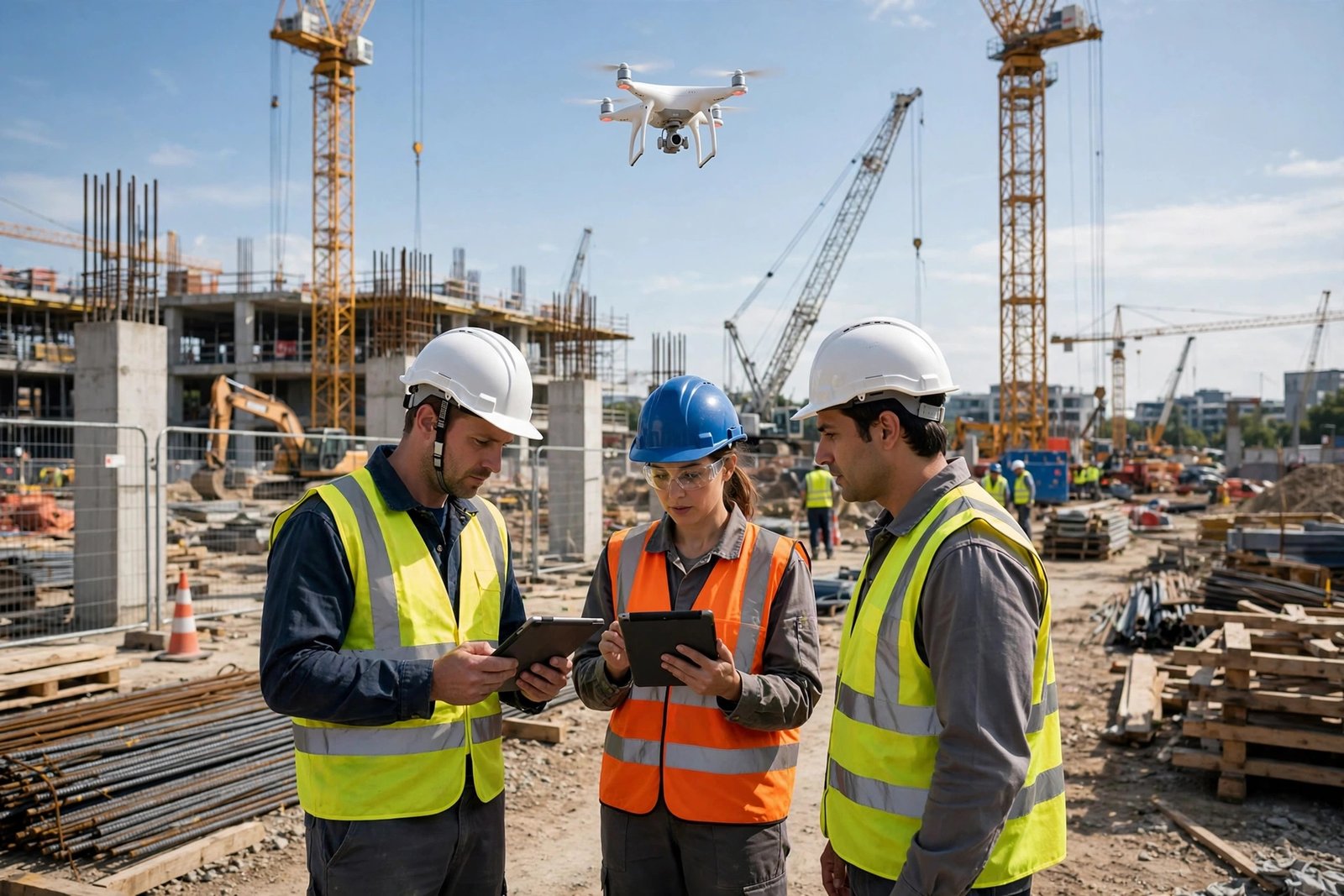
Why Construction Technology Matters Now
Construction has historically lagged other industries in technology adoption — and that is precisely why the current wave matters. Labor shortages, tight margins, safety pressures, and sustainability mandates are forcing rapid change. Industry analyses consistently rank construction among the least digitized major sectors, which means even modest technology adoption delivers outsized productivity gains.
The stakes are enormous. Construction accounts for a significant share of global economic output and employment, and its productivity has barely budged in decades while manufacturing and agriculture soared. Technology is finally cracking that puzzle — and the companies and workers who adapt early are pulling ahead.
Key Innovation Areas in Construction Tech Today
Building Information Modeling (BIM)
BIM remains the digital backbone of modern construction. These 3D models carry far more than geometry — they embed materials, costs, schedules, and maintenance data for every component. Today’s news in BIM centers on wider adoption mandates, cloud-based collaboration that lets architects, engineers, and contractors work on a single live model, and integration with field tools so the model stays accurate as building progresses. For firms still working from 2D drawings, BIM adoption is the single highest-impact technology move available.
Drones and Aerial Surveying
Drones have gone from novelty to standard equipment. A drone survey that once took a survey crew days now takes an hour, producing topographic maps, progress photos, and volumetric measurements of stockpiles. Regular drone flights create a visual timeline of the project, invaluable for resolving disputes and documenting progress for clients. Regulatory frameworks have matured to match, with clearer rules for commercial operations in most jurisdictions.
Robotics and Automation
Construction robots are moving from trade shows to job sites. Bricklaying robots, rebar-tying machines, autonomous earthmovers, and demolition robots handle tasks that are dangerous, repetitive, or physically punishing. The pitch is not replacing workers — the industry cannot hire enough people as it is — but amplifying the crews available. Expect this category to generate some of the most dramatic headlines in construction technology news over the next few years.
Artificial Intelligence and Predictive Analytics
AI is finding practical footholds in construction: predicting schedule delays from progress data, optimizing equipment deployment, scanning contracts for risky clauses, and analyzing safety camera footage to flag hazards. Unlike consumer AI hype, construction AI stories tend to be grounded in measurable outcomes — fewer delays, lower costs, fewer incidents — which makes this beat unusually substantive.
Wearables and Worker Safety Tech
Smart helmets, connected vests, exoskeletons, and environmental sensors are making job sites safer and more productive. Proximity alerts warn workers near heavy equipment, fatigue monitors flag dangerous exhaustion, and exoskeletons reduce strain injuries. Given construction’s safety record, technology that prevents even a fraction of incidents carries both moral and financial weight.
3D Printing and Offsite Construction
3D-printed buildings have graduated from experiments to real projects — homes, offices, and infrastructure components printed layer by layer. Parallel to this, modular and offsite construction moves more work into factories, where conditions are controlled and automation is easier. Both approaches attack construction’s core inefficiency: building everything outdoors, from scratch, in variable weather.
Software: The Quiet Revolution
Behind the dramatic hardware stories, software is transforming how construction companies operate — and this is where most firms will feel the change first.
Project Management Platforms
Cloud-based project management has replaced the trailer full of paper drawings. Daily logs, RFIs, change orders, punch lists, and photo documentation now live in shared platforms accessible from the field on tablets and phones. The result is fewer miscommunications — historically one of construction’s costliest problems.
Estimating and Bidding Tools
AI-assisted takeoff and estimating tools dramatically speed up bid preparation while improving accuracy. In an industry where winning work depends on bidding correctly, this software directly affects the bottom line.
SaaS and the Subscription Shift
Like every other industry, construction is shifting from purchased software to cloud subscriptions. This lowers the entry cost for small firms while creating ongoing expenses that need managing. Understanding the broader landscape of SaaS and AI services for small businesses helps construction firms evaluate vendors wisely rather than accumulating redundant subscriptions.
Accounting and Back-Office Integration
Job costing, payroll for prevailing-wage compliance, and equipment tracking are increasingly integrated with field operations. The firms gaining the most are those connecting office and field data — so the trailer knows what the back office knows, in real time.

Sustainability and Green Building Tech
Environmental pressure is reshaping construction technology priorities. Buildings account for a large share of global energy use and emissions, and both regulation and client demand are pushing the industry toward greener methods.
Low-Carbon Materials
Innovation in materials — low-carbon concrete, mass timber, recycled steel, bio-based insulation — is one of the most active areas in construction technology news. These materials can dramatically cut a project’s embodied carbon, and green building certifications increasingly reward their use.
Energy Modeling and Monitoring
Software that models building energy performance during design, plus sensors that verify it during operation, are closing the gap between predicted and actual efficiency. This matters as energy codes tighten worldwide.
Waste Reduction Through Precision
Construction generates enormous waste, much of it from over-ordering and rework. BIM-driven precision ordering, modular construction, and better logistics are cutting waste substantially — saving money while reducing environmental impact.
Major Trends Shaping the Industry
The Labor Shortage Accelerant
Skilled labor shortages are the single biggest driver of construction technology adoption. With experienced workers retiring faster than replacements arrive, firms are turning to technology not as a luxury but as a necessity. This dynamic means construction tech adoption is less cyclical than in other industries — it persists through downturns because the underlying labor math does not change.
Consolidation and Investment
Venture funding for construction technology has grown enormously, and established industry giants are acquiring startups aggressively. For buyers, this means powerful integrated platforms — but also vendor lock-in risks worth evaluating before committing.
Data as a Strategic Asset
Forward-thinking firms treat project data — costs, durations, safety incidents, productivity rates — as an asset to be captured systematically. Over time, this data becomes a competitive advantage in bidding and execution that competitors cannot easily replicate.
Regulatory Tailwinds
Government mandates for BIM on public projects, tightening safety regulations, and green building requirements are pushing laggards toward adoption. Public infrastructure spending in many countries explicitly favors firms with modern digital capabilities.
How to Evaluate Construction Technology for Your Business
Headlines showcase the spectacular; buying decisions require the practical. This framework helps separate useful tools from expensive distractions.
- Start from a real problem. Identify your costliest pain point — rework, delays, safety incidents, bidding accuracy — and evaluate technology against it specifically.
- Pilot before committing. Run a controlled trial on one project with clear success metrics before rolling out company-wide.
- Count total cost. Include hardware, software subscriptions, training, integration, and the productivity dip during transition.
- Check interoperability. Tools that do not integrate with your existing systems create data silos instead of solving them.
- Plan for people. Budget as much for training and change management as for the technology itself — adoption fails on human factors more often than technical ones.
- Verify claims independently. Ask vendors for customer references and measurable results, not just demonstrations.
Following Construction Technology News Effectively
The construction tech beat rewards focused attention. General technology news coverage provides useful context on AI, drones, and software trends, but specialist construction publications cover applications and case studies the general press misses. Trade shows and demo days offer hands-on evaluation that articles cannot match.
For professionals, the career angle matters too: construction technology is creating new roles — BIM coordinators, drone operators, data analysts, VDC managers — that did not exist a decade ago. Workers who combine field experience with digital skills are among the industry’s most sought-after hires, a dynamic explored in our overview of technology solutions career paths.
Challenges and Honest Criticisms
Enthusiasm for construction technology should be balanced with clear-eyed recognition of its limits. Not every innovation delivers, and some create new problems.
High Upfront Costs
Advanced robotics, comprehensive sensor networks, and enterprise software platforms require significant investment. For small and mid-sized contractors operating on thin margins, the payback period can be uncomfortably long — which is why adoption often starts with low-cost software rather than headline-grabbing hardware.
Integration Headaches
The industry suffers from fragmented software: estimating tools that do not talk to scheduling tools that do not talk to accounting systems. Until interoperability improves, firms spend considerable effort stitching systems together or accept the inefficiency of disconnected data.
The Skills Gap Within the Skills Gap
Construction already struggles to hire; construction technology adds demand for workers who combine field knowledge with digital fluency. Training programs are expanding but have not caught up, leaving many firms with tools their teams cannot fully use.
Overpromising Vendors
As in every tech boom, some vendors oversell. Pilot results achieved under ideal conditions may not survive contact with a muddy, chaotic real job site. Skeptical evaluation — reference customers, measured outcomes, trial periods — remains essential.

Frequently Asked Questions
What is construction technology (contech)?
Construction technology — ‘contech’ — refers to digital tools, software, robotics, and innovative methods used to plan, design, build, and manage construction projects more efficiently, safely, and sustainably.
What are the biggest construction tech trends right now?
BIM adoption, drones for surveying, construction robotics, AI for scheduling and safety, wearable safety devices, 3D printing, modular construction, and cloud-based project management platforms are the dominant trends.
How are drones used in construction?
Drones perform topographic surveys, track progress with regular photo documentation, measure stockpile volumes, inspect hard-to-reach structures, and create visual records useful for client reporting and dispute resolution.
Will robots replace construction workers?
Not in the foreseeable future. The industry faces severe labor shortages, so robotics is deployed to amplify existing crews and handle dangerous or repetitive tasks — not to eliminate jobs. New roles operating and maintaining the robots are being created simultaneously.
What is BIM and why does it matter?
Building Information Modeling creates intelligent 3D models containing geometry plus data on materials, costs, and schedules. It reduces errors, improves coordination between trades, and is increasingly mandated for public projects.
How can a small construction firm start adopting technology?
Start with cloud-based project management and estimating software — low cost, immediate impact. Pilot drones or BIM on a single project before wider rollout, and invest in training alongside any tool purchase.
Where can I follow daily construction technology news?
Specialist construction tech publications, industry association newsletters, and trade show coverage provide the most relevant updates. General tech news covers the underlying technologies — AI, drones, software — that construction then applies.
Conclusion
Construction technology has moved past the experimentation phase. Drones, BIM, AI scheduling, robotics, and cloud platforms are delivering measurable results on real projects today, driven by labor shortages and margin pressure that make adoption a necessity rather than a choice. The firms thriving in this transition share a pattern: they start from real problems, pilot carefully, invest in their people, and treat data as an asset. Follow the news, but buy the outcomes — and the future of building will belong to those who build smarter, not just harder. The transformation is already underway on job sites around the world; the only open question is how quickly each firm and worker chooses to be part of it.



Leave a Reply